Most fractional CMOs in the US charge $5,000 to $25,000 a month on retainer, and most working engagements land between $8,000 and $15,000 (Web Tonic). A fractional CRO averages about $202 an hour, which comes to $6,600 to $11,000 a month at a typical 11 hours a week (Go Fractional). The price rises as the scope grows from advising the founder to running the revenue team.
The monthly number is the wrong place to start. A retainer only makes sense once you know what is actually holding growth back. For most founders, a short paid diagnosis is the cheapest way to find out, and it tells you whether you need a CMO, a CRO, or neither.
Fractional CMO and CRO pricing at a glance
These are the 2026 US market ranges founders are most likely to be quoted.

| Engagement | Typical price (USD) | Source |
|---|---|---|
| Fractional CMO, monthly retainer | $5,000 to $25,000 a month, most between $8,000 and $15,000 | Web Tonic |
| Fractional CMO, hourly advisory | $200 to $500 an hour | Web Tonic |
| Fractional CMO, day rate | $1,200 to $2,500 a day | Go Fractional |
| Fractional CMO, defined project | $8,000 to $50,000 | Web Tonic |
| Fractional CRO, part time (about 11 hours a week) | $6,600 to $11,000 a month, $202 an hour on average | Go Fractional |
| Fractional CRO, ongoing leadership retainer | $10,000 to $20,000 a month | My Personal Recruiter |
What people actually charge runs lower than most published guides. In a survey of 250 fractional professionals, 40% charged $5,000 to $8,000 a month and only 12% charged more than $10,000 (Web Tonic, citing the FRAK State of Fractional report). The gap between asking and paying is real too. Fractional CROs ask $203 an hour on average, while companies post $130 (Go Fractional).
How are fractional executive engagements priced?
Most fractional leaders use a monthly retainer, and the other models exist for shorter or narrower work (Go Fractional).
- Monthly retainer. A fixed fee for an agreed number of hours or days. Best when you need ongoing leadership and want a predictable budget.
- Hourly or day rate. You pay for the time used. Fits audits, board prep, workshops, or a short burst before a launch. Short engagements often carry a higher hourly rate because the operator has to replace the client sooner.
- Project fee. A flat price for a defined outcome, such as a go-to-market plan or a repositioning. Good when the scope is clear and the end date matters.
- Value-based or performance pricing. Part of the fee is tied to results, like revenue growth over six months. It only works when the metric is clean and the executive controls enough of the levers to move it.
- Equity. Cash plus equity shows up mostly at seed stage and is uncommon later (Web Tonic). Treat it as a discount on cash, never as a replacement for a clear mandate.
There is one more model, and it is the one we use. You pay for a short diagnosis first, then price the ongoing work from what it finds. More on that below.
Fractional CMO or fractional CRO, which one do you need?
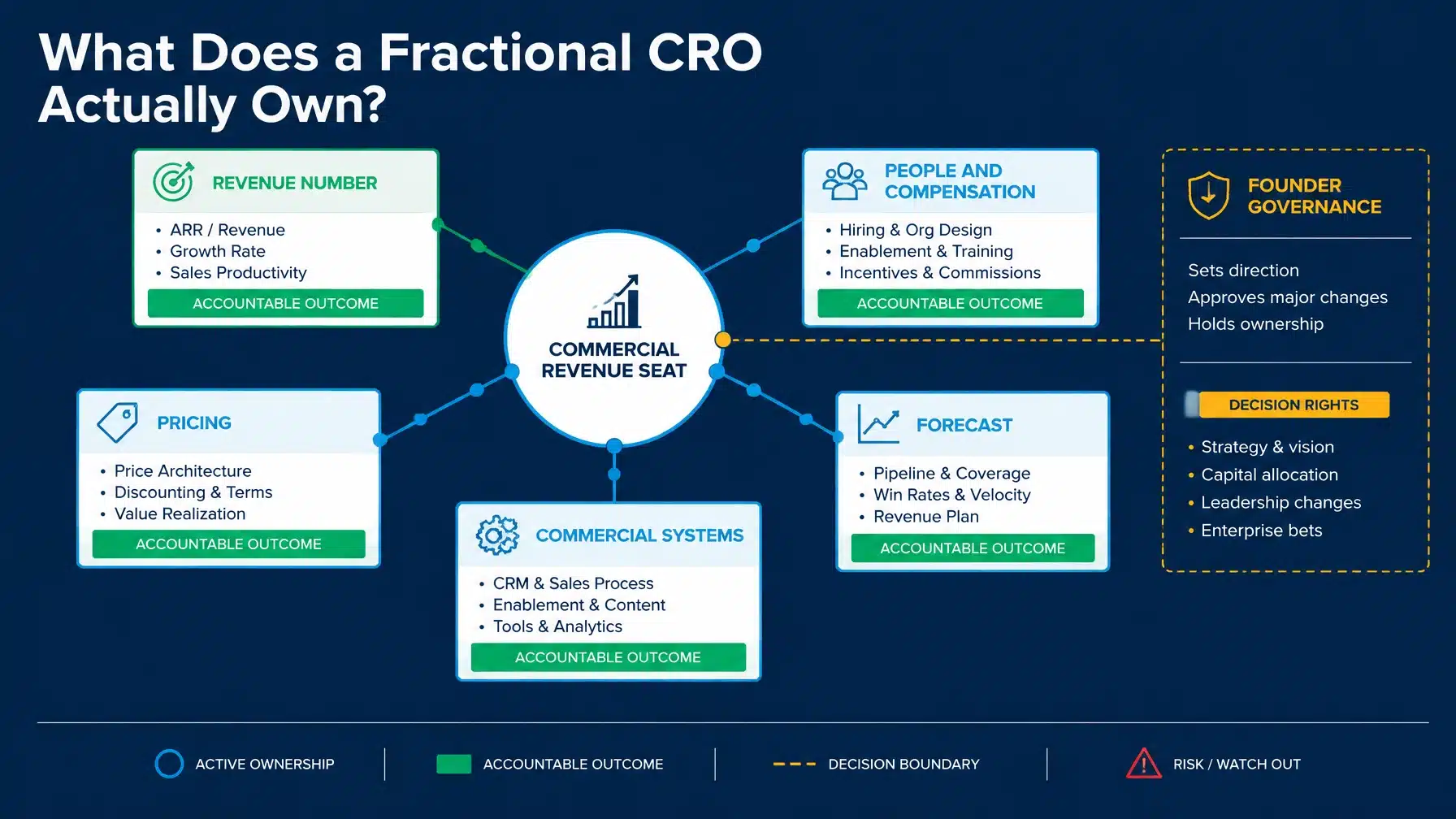
Hire a CMO when the problem is demand. Hire a CRO when the problem is turning demand into revenue. A CMO owns positioning, messaging, brand and pipeline creation. A CRO owns the whole revenue engine, which usually means sales, marketing, customer success, and revenue operations under one leader (My Personal Recruiter).
A quick way to tell them apart.
- You likely need a CMO if the right buyers don’t know you exist, your message sounds like every competitor, or your pipeline depends on the founder’s network.
- You likely need a CRO if leads come in, but deals stall, the forecast is a guess, marketing and sales blame each other, or deals fall through the handoff to customer success.
- You likely need neither yet if you have not found a repeatable buyer or a price people pay without heavy discounting. Leadership hours will not fix a product or market problem.
The CRO usually costs more because the scope is wider. At growth-stage companies, a full-time CRO’s on-target earnings run about $460,000 to $700,000, against $270,000 to $430,000 for a CMO (My Personal Recruiter).
One more thing founders tell us. Many never wanted to run sales in the first place. They want someone accountable for revenue so they can go back to product and the business. That is a CRO mandate, even if the job post says CMO.
What makes a fractional engagement cost more or less?
Time and scope set most of the price. The rest comes from risk, specialization, and how long you commit.
- Days per week. Going from one day to two roughly doubles the retainer, because the executive gives up capacity they could sell elsewhere (Web Tonic).
- Scope of ownership. Running the company’s revenue and reporting to the board costs more than supporting one function (Go Fractional).
- Team and vendors. Managing people and agencies is a different job from advising the founder, and it is priced that way.
- Stage and urgency. Turnarounds, interim roles, and fundraising moments raise the price (Go Fractional).
- Industry. Regulated sectors like financial services carry a premium for compliance judgment (Web Tonic).
- Commitment length. Six- and twelve-month terms usually price below month-to-month.
- Individual or firm. A firm with a delivery team costs more per month but brings people who execute. An independent operator quotes only their own time.
Compare quotes by effective hourly rate, not by the monthly number. A $10,000 retainer for 30 hours is about $333 an hour. The same retainer for 8 hours is $1,250 an hour.
Is a fractional executive cheaper than a full-time hire?
Yes, usually by half or more, until you need the person more than three days a week. A fractional CMO typically costs 25% to 50% of the all-in full-time cost (Web Tonic).
| Cost line | Fractional CMO or CRO | Full-time CMO | Full-time CRO |
|---|---|---|---|
| Average annual cash (USD) | $60,000 to $300,000 | $293,575 total compensation (Built In) | $416,766 total compensation, tech sector (Built In via My Personal Recruiter) |
| Benefits and payroll tax | None, billed as a vendor | Typically 20% to 30% on top of base | Typically 20% to 30% on top of base |
| Equity at growth stage | Rare after seed | 0.1% to 0.4% | 0.5% to 1.5% |
| Typical tenure | Set by contract | 4.1 years in the S&P 500 | About 25 months |
Equity and tenure figures come from My Personal Recruiter and Spencer Stuart, as cited by Web Tonic.
The tenure line matters more than founders think. CRO is the shortest-lived seat in the C-suite, and the usual cause is a mismatch between the mandate and the authority, not poor performance. A wrong full-time hire costs you the salary, the search, the ramp and the severance.
The math flips toward a full-time hire when leadership work fills more than three days a week, when the team grows past about eight people, or when marketing becomes the main revenue lever the board reviews every month (Web Tonic).
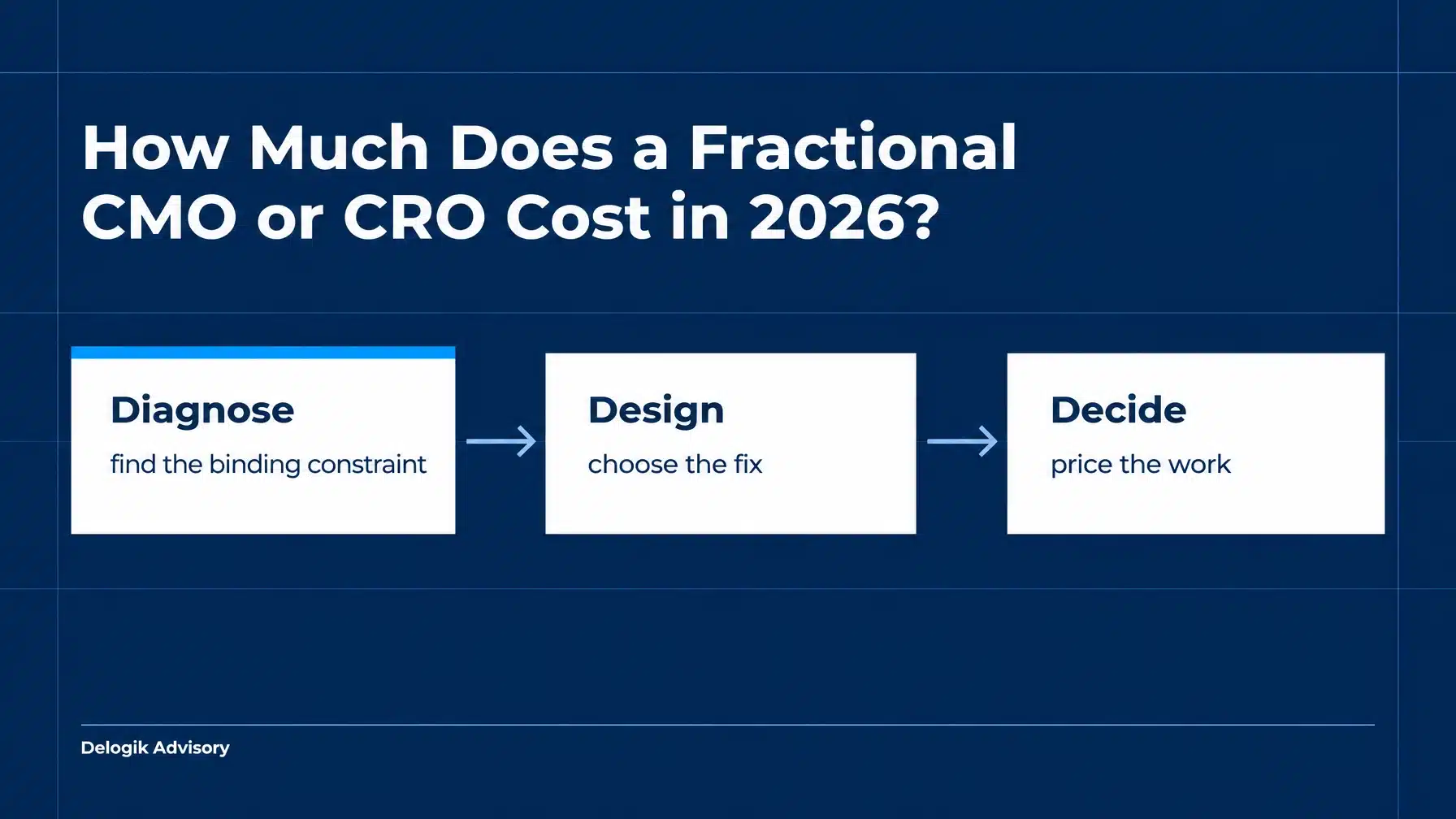
Why pay for a diagnosis before you pay for a retainer?
Because most founders who hire the wrong fractional executive were solving the wrong problem. Growth rarely stalls for ten reasons at once. It stalls because of one binding constraint, and everything else waits behind it. It might be the message, the buyer you are targeting, the price, the sales process, or the founder holding every deal. Until you know which, any retainer is a guess. You cannot out-market a leak.

A good diagnosis does four things.
- Names the one constraint holding growth back, with the evidence behind it.
- Tells you which role fixes it, a CMO, a CRO, an agency, a hire, or none of them.
- Puts a first motion into the market while the analysis happens, so you see execution in month one.
- Prices the rest of the work from what was found, not from a rate card.
It should be paid. A free roadmap is written to sell the retainer that follows it. A paid diagnosis has to be worth the money on its own, even if you never hire the person who wrote it.
When not to hire a fractional executive at all
- You have not found a buyer who pays repeatably without heavy discounting. That is a product and market problem, and leadership hours will not fix it.
- The real constraint is cash runway, product quality or a founder who will not let go of decisions.
- You need someone doing the daily work, writing, calling, running ads. That is a hire or an agency, not an executive.
- You can only fund two or three months. Most engagements need a full quarter just to show a reliable trend.
How Delogik prices its work
We publish our prices because founders should not have to book a call to find out. Every engagement starts with a paid diagnosis, and we price the rest based on what we find. Prices are in USD as of November 2026.
| Engagement | What you get | Price |
|---|---|---|
| Growth Diagnostic | One month. The binding constraint, the evidence, the role that fixes it, and one outreach motion live in the market | $6,000 |
| 90-Day Growth Sprint | The diagnostic as month one, then two months of executing the fix with you | $15,000, paid $5,500 a month after diagnostic |
| Ongoing revenue leadership | Fractional CRO or CMO leadership, scoped from the diagnosis | Typically $5,000 to $10,000 a month |
| CEO Strategy Circle | For owner-led companies above $3M in revenue. Weekly 1:1 strategy, async access and a monthly review | $4,500 a month |
We work best with funded B2B companies between $5M and $50M in revenue whose growth has stalled. If the diagnosis shows you do not need a fractional executive, we will tell you, and you keep the plan.
The diagnosis is the first phase of a structured go-to-market operating system, supported by Revenue Enablement, GTM Strategy, and CRM Implementation.
If you want the diagnosis before you pick a retainer, the Growth Diagnostic is built for exactly that.
Frequently asked questions
How much does a fractional CMO cost per month?
Most charge $5,000 to $25,000 a month in 2026, and most working engagements fall between $8,000 and $15,000 (Web Tonic).
How much does a fractional CRO cost per month?
At about 11 hours a week, a fractional CRO costs $6,600 to $11,000 a month (Go Fractional). Leaders who run the full revenue team usually charge $10,000 to $20,000 (My Personal Recruiter).
What is the hourly rate for a fractional CMO or CRO?
Fractional CMOs charge $200 to $500 an hour for advisory work. Fractional CROs average $202 an hour, with the middle half of the market between $150 and $250.
How many hours a week does a fractional executive work?
A fractional CRO typically works about 11 hours a week (Go Fractional). Fractional CMOs average closer to 20 hours a week on Go Fractional’s platform, which recommends at least 10 (Go Fractional).
Should I pay a fractional executive in equity?
Only at seed stage, and only as a partial discount on cash. Keep the scope, metrics, and notice period in writing either way.
How long should a fractional engagement last?
Plan for at least one quarter. Most retainers assume six months or more, and shorter engagements rarely show a reliable trend.
What should a fractional executive contract include?
The split between leadership and execution work, the hours and days, the two or three metrics that judge success, the notice period, and what gets handed over at the end.
Sources
- Fractional CMO: what it costs in 2026, Web Tonic, updated October 9, 2026
- Fractional CRO Cost and Rates, Go Fractional, updated November 3, 2026
- Fractional CMO Cost, 2026 Rates by Engagement Type, Go Fractional, updated August 13, 2026
- CRO Salary Guide, What Chief Revenue Officers Earn in 2026, My Personal Recruiter, updated August 5, 2026
- CMO Salary in US, Built In, 2026