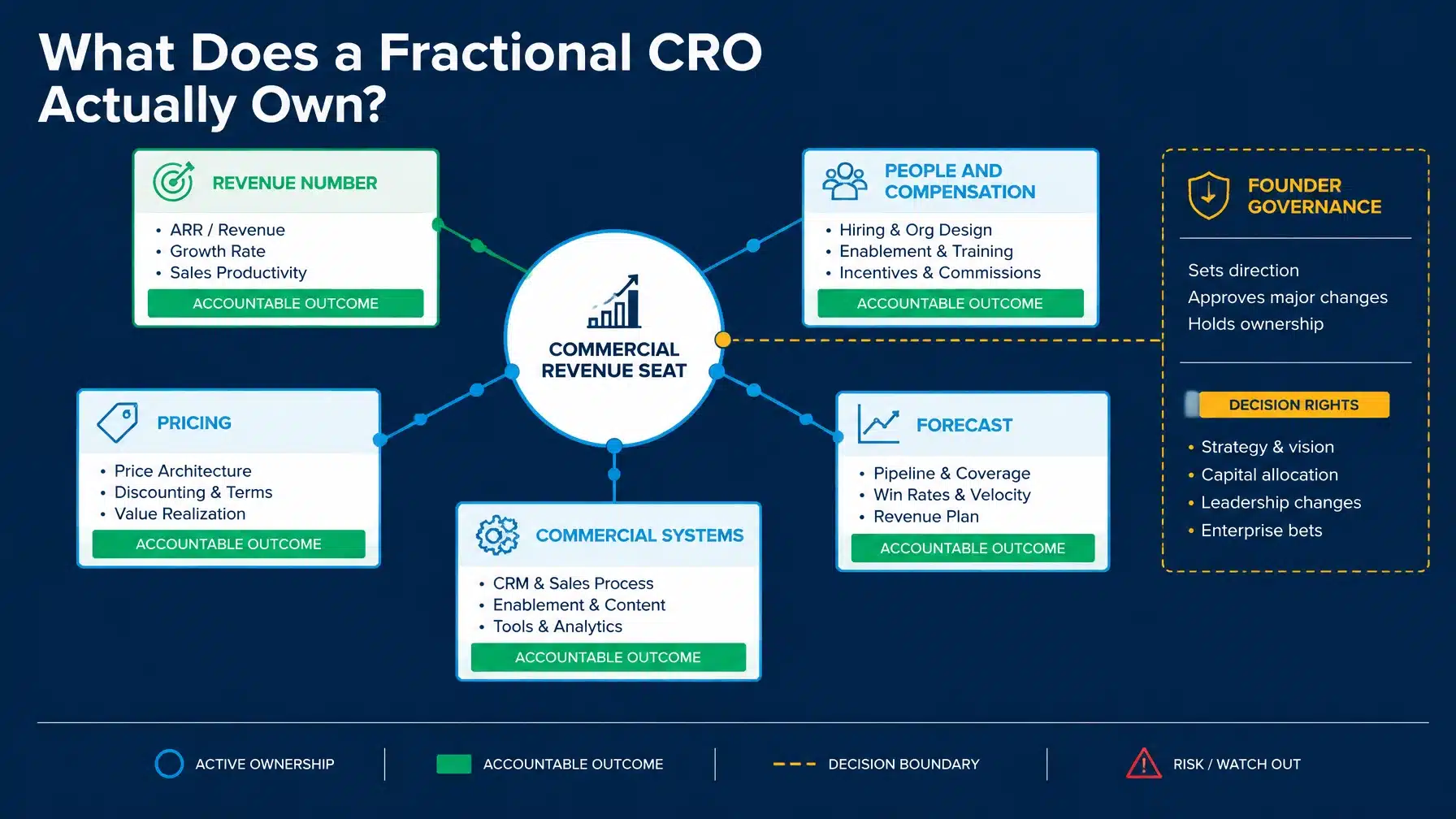
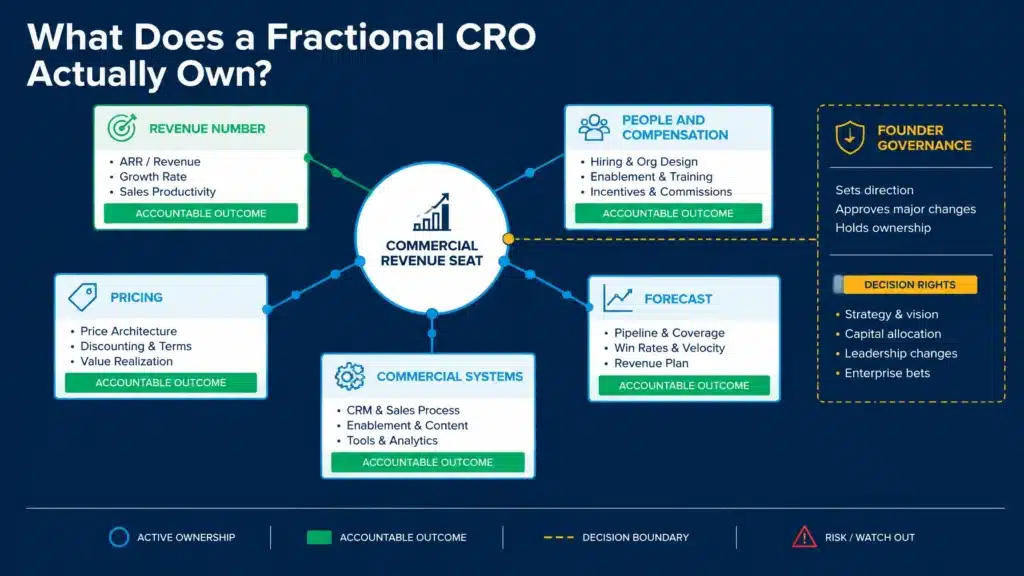
The fractional CRO owns the commercial outcome and the decisions that determine it.
A fractional CRO owns the revenue number and the commercial decisions behind it, including priorities, forecast, people, compensation, pricing, and commercial systems. The role is a senior operator engaged part-time with full authority over the commercial mandate. It is accountable for outcomes, not simply meetings, recommendations, or activity.
At Delogik Advisory, Ricardo Vanegas owns the revenue number for B2B SaaS and fintech companies. The starting point is not a sales playbook or a new CRM dashboard. It is the binding constraint.
A binding constraint is the specific condition that currently limits revenue performance more than any other condition.
A fractional CRO is a senior commercial operator who leads the revenue function part-time, with defined authority and accountability.
The distinction matters because many companies buy advice when they need ownership. They commission activity when they need decisions. They add meetings when they need a commercial operating system.
The mandate is simple to state and difficult to fake.
Own the number, not the meetings.
What does a fractional CRO actually do and own?
A fractional CRO with full commercial authority owns the decisions that connect market demand to revenue performance. That authority includes people, compensation, pricing, commercial systems, and forecast management without requiring founder sign-off for each commercial decision.
This is the sharpest difference between a true fractional CRO and an adjacent service provider.
The role does not mean attending a weekly pipeline meeting, reviewing dashboards, or giving the CEO a list of recommendations. Those activities can be part of the work. They are not the mandate.
The mandate includes these concrete accountabilities.
Does the fractional CRO own the revenue number?
Yes.
The fractional CRO owns the commercial target and the assumptions behind it. That includes new business, expansion, retention inputs, pipeline coverage, conversion rates, sales cycle, average contract value, and forecast reliability.
Ownership does not mean controlling every variable. Product quality, market conditions, capital constraints, and customer behavior still affect results. It means the CRO has the authority to identify the commercial response and act on it.
A fractional CRO should be able to answer:
- What revenue outcome is required?
- Which revenue streams contribute to that outcome?
- What pipeline is required to support the target?
- Which conversion rate is limiting performance?
- Which segment, channel, or offer deserves more investment?
- What decision will change the result within the next 30, 60, or 90 days?
If no one owns those questions, the company has a revenue target but no accountable revenue owner.
Does the fractional CRO own the diagnosis?
Yes.
Before prescribing a solution, the fractional CRO diagnoses the commercial system. This is the first phase of Delogik Advisory’s method, Insight Mining.
The diagnosis examines:
- Market and segment focus
- Ideal customer profile quality
- Positioning and commercial narrative
- Lead sources and demand quality
- Pipeline creation and pipeline movement
- Sales process and qualification
- Pricing and packaging
- Customer onboarding and time-to-value
- Expansion and retention signals
- CRM integrity and reporting
- Team structure and role clarity
- Forecast accuracy and operating cadence
The purpose is not to produce a longer list of problems. It is to identify the one condition that most restricts revenue performance.
A company that needs more qualified demand should not begin with sales training. A company with weak conversion should not automatically increase marketing spend. A company with unreliable data should not make hiring decisions from a forecast it cannot trust.
The diagnosis determines the sequence.
Does the fractional CRO own the priorities?
Yes.
Once the binding constraint is clear, the fractional CRO owns the commercial priorities. This is Direction Design, the second phase of the operating method.
Direction Design turns a broad growth objective into a small set of decisions:
- Which market or segment receives priority?
- Which offer or use case leads the commercial motion?
- Which pipeline source deserves investment?
- Which sales stages require redesign?
- Which roles need to change?
- Which pricing decisions are required?
- Which systems or data gaps must be corrected?
- Which initiatives stop because they do not address the constraint?
A CRO is not useful if every initiative remains active. Commercial leadership requires choosing what will not receive attention.
The leadership team must be able to see the priority list. It must also connect directly to revenue metrics. A priority without a measurable commercial effect is an activity. A priority with an owner, decision date, and expected revenue effect is an operating commitment.
Does the fractional CRO own the operating cadence?
Yes.
The fractional CRO establishes how commercial decisions are made and reviewed. This includes the meetings, information flows, escalation rules, and decision rights that keep the revenue function moving.
A useful operating cadence usually includes:
- A weekly pipeline and forecast review
- A regular deal inspection for strategic opportunities
- A monthly performance review against the revenue plan
- A recurring marketing and sales alignment review
- A customer health and expansion review
- A quarterly priority reset
The cadence is not designed to create more internal administration. It is designed to move decisions closer to the point where revenue is created or lost.
Each meeting should answer three questions:
- What changed?
- What decision is required?
- Who owns the next action and by when?
If a commercial meeting ends with updates but no decisions, it is not an operating cadence. It is reporting theater.
Does the fractional CRO own people and compensation decisions?
Yes, when the mandate grants full commercial authority.
That authority includes the ability to:
- Define commercial roles
- Set performance expectations
- Reassign responsibilities
- Approve or recommend hiring decisions within the commercial function
- Identify performance gaps
- Establish sales compensation principles
- Adjust incentive structures
- Set management expectations
- Determine whether the current structure supports the revenue plan
Compensation is a commercial system. It tells the team what the company values and what behavior it will reward.
A compensation plan that rewards closed bookings while creating poor-fit customers creates downstream revenue problems. A plan that rewards activity without qualified pipeline creates inflated reporting. A plan that pays for expansion but gives no one responsibility for adoption produces internal conflict.
The fractional CRO must be able to connect compensation to the commercial strategy. That does not mean every employment decision sits outside the CEO’s legal or governance responsibilities. It means the CRO owns the commercial recommendation and has the authority to implement decisions within the agreed mandate.
Does the fractional CRO own pricing?
Yes.
Pricing is a revenue decision, not only a product or finance decision. The fractional CRO owns the commercial consequences of pricing, packaging, discounting, and negotiation.
That includes deciding:
- Which offer is sold to which segment
- How packages are structured
- When discounts are permitted
- Who can approve exceptions
- How value is communicated
- When pricing should be tested
- Which customers receive expansion offers
- How sales compensation interacts with pricing behavior
Pricing decisions should be based on market evidence, customer value, win-and-loss patterns, sales friction, and unit economics.
The CRO does not set pricing in isolation. Product, finance, legal, and the CEO still contribute important input. The CRO owns the commercial decision process and the revenue consequences.
Does the fractional CRO own the commercial system?
Yes.
A commercial system is the connected set of processes, tools, data, and management rules used to create and retain revenue.
It includes:
- Go-to-market strategy
- Market segmentation
- Demand creation
- Lead management
- Qualification
- Sales stages
- Forecasting
- Customer onboarding
- Expansion
- Retention
- CRM structure
- Reporting
- Revenue enablement
This is where Revenue Operations, or RevOps, becomes relevant. RevOps is the operating discipline that connects people, process, data, and technology across marketing, sales, customer success, and finance to improve revenue performance.
The CRO owns the commercial system. RevOps often owns the operating infrastructure that supports it. In a well-designed organization, the CRO sets the commercial direction, and RevOps makes the system visible, consistent, and measurable.
For companies that need to centralize their revenue data and improve system integrity, a CRM implementation service can support the technical work. The CRO still owns the commercial decisions that the system must enable.
Does the fractional CRO own the forecast?
Yes.
The forecast is not a spreadsheet exercise. It is a statement of commercial confidence.
The fractional CRO owns:
- Forecast definitions
- Stage criteria
- Commit and best-case categories
- Pipeline coverage requirements
- Deal inspection standards
- Slippage analysis
- Forecast updates
- Variance explanations
- Corrective actions
A reliable forecast does not require perfect prediction. It requires consistent definitions, disciplined inspection, and visible assumptions.
If a deal is included in commit because a seller feels confident, the forecast is not reliable. If the CRM stage does not reflect buyer behavior, the forecast is not reliable. If the company changes definitions every month, the forecast is not comparable.
The CRO’s job is to make the forecast useful for decisions.

The commercial mandate gives the fractional CRO authority over revenue decisions while the founder or CEO retains company-level governance.
What does a fractional CRO not own?
A credible mandate has a boundary.
The fractional CRO owns the commercial function. The founder or CEO still owns the company.
The founder or CEO generally retains final authority over:
- Company vision and purpose
- Capital allocation
- Board commitments
- Major financing decisions
- Product risk
- Legal and regulatory exposure
- Ownership structure
- Executive employment decisions required by governance
- Material changes to company strategy
- Decisions that create obligations outside the commercial mandate
This boundary does not weaken the fractional CRO role. It defines it.
The mistake is giving the CRO responsibility for the number while requiring founder approval for every decision that affects it. That creates accountability without authority.
A functional mandate should answer the following before the engagement begins:
| Decision area | Fractional CRO authority | Founder or CEO role |
|---|---|---|
| Revenue target | Owns the plan and commercial response | Approves company-level target |
| Hiring within revenue | Recommends and manages commercial structure | Retains governance and employment authority where required |
| Compensation | Designs and adjusts commercial incentives | Approves within company policy and budget |
| Pricing | Owns commercial pricing decisions | Reviews material strategic or financial implications |
| CRM and RevOps | Defines requirements and operating standards | Supports investment and company-wide adoption |
| Forecast | Owns definitions, accuracy, and corrective action | Uses forecast for company decisions |
| Product direction | Provides market and revenue evidence | Owns product strategy and risk |
| Capital allocation | Recommends commercial investment | Owns final capital decisions |
| Board communication | Provides commercial reporting | Owns formal board accountability |
The practical test is simple.
If the CRO cannot change the people, compensation, pricing, or systems required to address the binding constraint, the mandate is advisory. If the CRO has authority in those areas and is measured on the result, the mandate is operational.
How does a fractional CRO differ from a consultant, agency, sales coach, or VP of Sales?
The difference is ownership.
A consultant advises. An agency executes a defined scope. A sales coach improves individual or team capability. A VP of Sales leads the sales function. A fractional CRO owns the broader commercial outcome when the mandate includes full commercial authority.
Fractional CRO vs. adjacent models
| Model | What it owns | What it produces | Decision authority | Best fit |
|---|---|---|---|---|
| Fractional CRO | Revenue outcome and commercial system | Priorities, decisions, forecast, team structure, pricing direction, operating cadence | Full commercial authority within mandate | Companies that need an accountable revenue owner before or instead of a full-time CRO |
| Consultant | Analysis and recommendations | Assessment, strategy, options, roadmap | Usually advisory | Companies that need independent diagnosis or specialist expertise |
| Agency | Defined execution scope | Campaigns, creative, demand programs, implementation work, or other contracted outputs | Authority over its scope, not the full commercial system | Companies that need marketing or implementation capacity at scale |
| Sales coach | Seller and manager capability | Coaching, role plays, feedback, methodology adoption | Limited authority over company decisions | Teams that need skill development and sales management support |
| VP of Sales | Sales team and sales execution | Hiring, management, pipeline performance, sales process, forecast | Authority over sales, usually narrower than full commercial authority | Companies with a defined sales function that needs a permanent sales leader |
| Full-time CRO | End-to-end commercial function | Long-term revenue strategy, team, systems, forecast, and execution | Permanent executive authority | Companies with enough scale, complexity, and duration to support a full-time executive role |
The distinction between a fractional CRO and a VP of Sales is especially important.
A VP of Sales typically owns sales execution. A CRO owns the commercial system across demand, sales, customer value, expansion, RevOps, pricing, and revenue planning. In some companies, the VP of Sales reports to the CRO. In others, the VP of Sales carries broader responsibility. The title doesn’t define the mandate. Decision rights do.
Is a fractional CRO the same as a consultant?
No.
A consultant can diagnose the business and recommend a course of action. A fractional CRO diagnoses the business, sets the priorities, makes commercial decisions, directs the operating cadence, and accepts accountability for the revenue outcome.
A consultant’s deliverable may be a strategy document. A fractional CRO’s deliverable is a better commercial system and a measurable change in revenue performance.
There is value in both models. They solve different problems.
Is a fractional CRO the same as an agency?
No.
An agency provides execution capacity. That may include demand generation, content, paid media, design, CRM administration, or campaign management.
A fractional CRO decides which execution is required, why it matters, how it connects to the revenue plan, and whether it is producing the intended result. The CRO can bring in the right execution partners after diagnosing the constraint.
The agency executes the fix. The fractional CRO owns whether the fix was the right one.
Is a fractional CRO the same as a sales coach?
No.
A sales coach improves seller behavior and management skill. That can increase performance when the constraint is capability.
It will not solve a poorly defined market, weak pricing, broken handoffs, unreliable data, or an incentive plan that rewards the wrong behavior. Sales coaching is valuable when the system is clear and the team needs to perform inside it.
What happens in the first 30, 60, and 90 days?
The first 90 days should be defined by decisions, not activity.
The exact sequence varies by company, but the operating logic remains consistent.

The first 90 days should move from diagnosis to priority decisions and then to integrated deployment.
What should happen in days 1 through 30?
The first 30 days are for Insight Mining and mandate clarification.
The fractional CRO should decide:
- What revenue number is being owned
- Which commercial metrics are trustworthy
- Where the pipeline is created and lost
- Which customer segments are economically attractive
- Which parts of the sales process reflect buyer behavior
- Whether pricing creates friction
- Whether the team structure matches the commercial plan
- Whether the CRM reflects reality
- Which condition is the binding constraint
The output is not a list of 40 initiatives. It is a current-state diagnosis, a revenue baseline, and a clear statement of the primary constraint.
Outcome: The company knows what is restricting revenue and what decisions require commercial authority.
What should happen in days 31 through 60?
Days 31 through 60 are for Direction Design.
The fractional CRO should decide:
- Which segment receives priority
- Which offer or use case leads the market motion
- Which pipeline sources receive investment
- Which stages or qualification rules change
- Which people and roles need to change
- Which compensation mechanics need adjustment
- Which pricing decisions are required
- Which CRM fields, workflows, and reports become mandatory
- Which initiatives stop
The result should be a short commercial plan with owners, dates, metrics, and decision rights.
This is also when the operating cadence becomes real. Forecast definitions are set. Pipeline inspection standards are established. Marketing, sales, customer success, and RevOps understand how their work connects to the revenue plan.
Outcome: The company has a prioritized commercial direction and a management system for executing it.
What should happen in days 61 through 90?
Days 61 through 90 are for Execution Integration.
Execution Integration means deploying the selected fix through the right people, processes, systems, and partners. The fractional CRO does not need to execute every task personally. The CRO owns the integration and the commercial result.
The CRO should decide:
- Which execution partners or internal owners are required
- Which process changes are live
- Whether the team is following the new operating standards
- Whether the forecast is improving
- Whether pipeline quality is changing
- Whether pricing and qualification decisions are producing better outcomes
- Whether the company is ready to scale the motion
- What responsibility can transfer to a permanent leader or internal owner
Outcome: The company has a functioning commercial system, visible accountability, and a clear next-stage leadership requirement.
The first 90 days don’t promise that every revenue problem will disappear. They are a test of whether the company can identify the constraint, make decisions, and operate with discipline.
How should success be measured?
A fractional CRO should be measured on outcomes and leading indicators.
Revenue is the primary outcome. It is not the only useful measure during an early engagement because revenue often reflects decisions made several weeks or months earlier.
A founder or CEO should inspect the following metrics.
Revenue outcomes
- New recurring revenue
- Expansion revenue
- Retention and churn
- Gross revenue retention
- Net revenue retention
- Average contract value
- Revenue by segment
- Revenue by channel
- Revenue against plan
Pipeline quality
- Qualified pipeline coverage
- Pipeline created during the period
- Conversion by stage
- Win rate
- Sales cycle length
- Deal slippage
- Average time between stages
- Pipeline concentration by account or segment
Commercial system health
- Forecast accuracy
- CRM completeness
- Stage aging
- Activity tied to qualified opportunities
- Lead-to-opportunity conversion
- Opportunity-to-close conversion
- Handoff completion
- Customer time-to-value
- Expansion opportunity identification
People and management
- Rep productivity
- Ramp time
- Quota attainment
- Manager inspection quality
- Compensation alignment
- Role clarity
- Performance management actions completed
Set precise targets from the company’s baseline. A metric without a baseline encourages arbitrary judgment.
What failure signals should a founder watch for?
The following signals indicate that the fractional CRO mandate is not working or is not being supported:
- The CRO reports activity but avoids revenue accountability.
- Priorities expand instead of narrowing.
- The forecast changes without clear reasons.
- Pipeline grows while qualified conversion declines.
- The founder still approves every pricing or people decision.
- Commercial meetings produce updates but no decisions.
- The CRM remains optional.
- Compensation rewards behavior that conflicts with the revenue plan.
- The CRO cannot name the binding constraint.
- Execution partners are added before the diagnosis is complete.
- The company measures meetings, calls, or campaigns without connecting them to revenue.
The most serious failure signal is authority mismatch.
If the company expects the fractional CRO to own the revenue number but does not grant the authority to act, the role cannot produce a fair result.
When is a fractional CRO the wrong choice?
A fractional CRO is not the correct answer to every commercial problem.
A different model is better when the company needs a specific capability rather than an accountable commercial owner.
A partner firm is the right choice when the company needs:
- Marketing execution at scale
- Paid media management
- Content production
- Brand or creative development
- Sales methodology training across a large team
- CRM administration without broader commercial leadership
- A defined implementation project
- Specialist research or analytics
- Temporary delivery capacity for a known program
A full-time CRO is the right choice when:
- The commercial mandate is permanent
- The company has enough operating complexity to require daily executive leadership
- The leadership team needs an embedded executive over multiple years
- The company can support the full compensation and employment commitment
- The organization has enough scale to sustain a permanent executive function
- The board expects a long-term executive owner inside the company
A VP of Sales is the better fit when the main need is sales team management and the rest of the commercial system is already clear.
The fractional CRO is the right choice when the company has a meaningful revenue problem, needs senior commercial judgment now, and is not yet ready to make a full-time CRO commitment.
This is not a ranking. It is a job-to-model decision.
How does Delogik Advisory approach the fractional CRO mandate?
Delogik Advisory uses a principal-led model. One senior operator sits in the revenue seat. The engagement is not a rotating team of junior resources and not a methodology license.
The work follows three phases.

The method moves from root-cause diagnosis to priority setting and integrated deployment.
Insight Mining
The first phase identifies the binding constraint.
Ricardo Vanegas examines the market, revenue data, customer journey, sales process, pricing, team structure, and operating system before prescribing a fix.
Direction Design
The second phase converts the diagnosis into a commercial direction.
This includes the target segment, offer, priorities, operating cadence, decision rights, metrics, and resource requirements.
Integrated Execution
The third phase deploys the fix through the right people, processes, systems, and partners.
This is where the commercial strategy becomes a working operating system. It includes management routines, CRM requirements, revenue enablement, execution coordination, and forecast discipline.
Companies that need a broader go-to-market strategy can use that service to clarify market focus, positioning, and commercial priorities. Companies that need the team to execute consistently can use revenue enablement to connect strategy, processes, skills, and technology.
For growth-minded companies operating across the United States and Latin America, the fractional CRO must also understand cross-border commercial decisions. Market entry, pricing, partnerships, sales coverage, customer expectations, and operating cadence can differ by country. The commercial system has to account for those differences without creating separate, disconnected motions.
The CEO Strategy Circle is relevant when the founder needs an ongoing strategic operating relationship while transitioning from Chief Everything Officer to company leader. The purpose is to help the CEO work on the business by clarifying decisions, installing systems, and creating accountability around the commercial engine.
Why is the fractional executive model growing?
The market is expanding because companies need senior judgment without committing to every full-time executive role at the same time.
The economic case is only part of the shift. Companies also need faster access to experienced operators, more flexible executive capacity, and direct accountability during transitions.
Market sizing varies by methodology. The Fractional Work Report 2026 from Fractional Jobs places the global fractional market in 2026 in a range of $5.7 billion to $9.4 billion, depending on the methodology used. The same report identifies approximately 150,000 fractional workers in the United States in 2026 and reports 149 percent year-over-year growth in hiring demand from the first quarter of 2025 to the first quarter of 2026.
The report also finds that a fractional executive working approximately 10 hours per week costs about half as much as a comparable fully loaded full-time hire. That is a market-level observation, not a guarantee for every role or engagement.
Ancore Partners reports that roughly 72 percent of CEOs plan to increase their use of fractional executives over the following 12 months, based on the sources cited in its 2026 executive hiring analysis.
The same Ancore Partners analysis cites a Gartner forecast that by 2027, more than 30 percent of midsize enterprises will retain at least one fractional executive.
These numbers describe adoption. They do not prove that every company needs a fractional CRO.
The model’s practical value is more specific. A company can access senior commercial judgment when revenue complexity has outgrown the founder, but before a permanent executive structure is justified.
At Delogik Advisory, the stated fractional CRO engagement range is around $8,000 to $15,000 per month when cost matters. The right comparison is not simply the monthly fee. It is the cost of delayed decisions, poor hiring sequence, weak forecast quality, unproductive pipeline, and commercial systems that cannot support the next stage of growth.
The model works when the company grants real authority, defines the revenue outcome, and expects the operator to make decisions.
Why is accountability the scarce input?
Most companies do not lack ideas.
They lack a person with the authority to decide which ideas matter, which initiatives stop, which people own the work, and how the result will be measured.
The fractional CRO fills that gap when the mandate is designed correctly.
The core value is not time. It is judgment applied to a commercial system with enough authority to act.
A consultant can identify the problem. An agency can execute a program. A sales coach can improve behavior. A VP of Sales can manage sellers. A full-time CRO can lead the permanent commercial function.
A fractional CRO is different because the role combines diagnosis, direction, authority, execution coordination, and accountability for the revenue number.
That is why the mandate must be explicit.
- Own the revenue number.
- Find the binding constraint.
- Set the priorities.
- Make the commercial decisions.
- Establish the operating cadence.
- Align people and compensation.
- Govern pricing.
- Build the commercial system.
- Make the forecast useful.
- Bring in the right execution partners.
- Transfer ownership when the company is ready.
The question for a founder or CEO is not whether a fractional CRO attends enough meetings.
The question is whether the role has enough authority to change the conditions that determine revenue.
Frequently asked questions
What does a fractional CRO actually do and own?
A fractional CRO owns the revenue outcome and the commercial decisions behind it. The mandate includes diagnosis, priorities, operating cadence, people and compensation decisions, pricing, commercial systems, and forecast management.
How much does a fractional CRO cost?
A fractional CRO engagement can vary by scope, authority, company stage, and market. The stated Delogik Advisory engagement range is $8,000 to $15,000 per month when the role includes full commercial authority.
Is a fractional CRO the same as a consultant?
No. A consultant primarily advises and produces analysis or recommendations, while a fractional CRO takes responsibility for commercial decisions and the revenue outcome within the agreed mandate.
How many hours per week does a fractional CRO work?
The schedule depends on the commercial mandate and the company’s operating needs. Fractional work is defined by scope and accountability rather than a fixed hour count, so the engagement should specify decision rights, cadence, availability, and expected outcomes.
How do you know if a fractional CRO is working?
Inspect revenue against plan, forecast accuracy, qualified pipeline, conversion by stage, sales cycle, deal slippage, CRM integrity, and progress against the binding constraint. The role is working when decisions become clearer, the commercial system becomes more reliable, and leading indicators improve in a way that supports revenue performance.
When should a company move from fractional to full-time?
A company should consider moving from fractional to full-time when the commercial mandate is permanent, the operating complexity requires daily executive presence, and the company can support the long-term role. The fractional CRO should help define that transition rather than create dependency on the engagement.
If you need to identify the commercial constraint before deciding between a fractional CRO, internal hire, or execution partner, schedule a GTM Assessment with Ricardo Vanegas.