For the modern SMB owner, the person who has built a $2M to $10M business on grit and local referrals, the “Chief Everything Officer” title isn’t a badge of honor anymore. It’s a bottleneck. You’ve likely experimented with traditional chatbots that follow rigid, frustrating decision trees. You know the ones: they offer a few buttons, fail to understand a complex question, and eventually drive your prospects to close the tab in annoyance.
But in 2026, the landscape has shifted. We have moved past the era of script-following bots and into the age of AI Sales Agents.
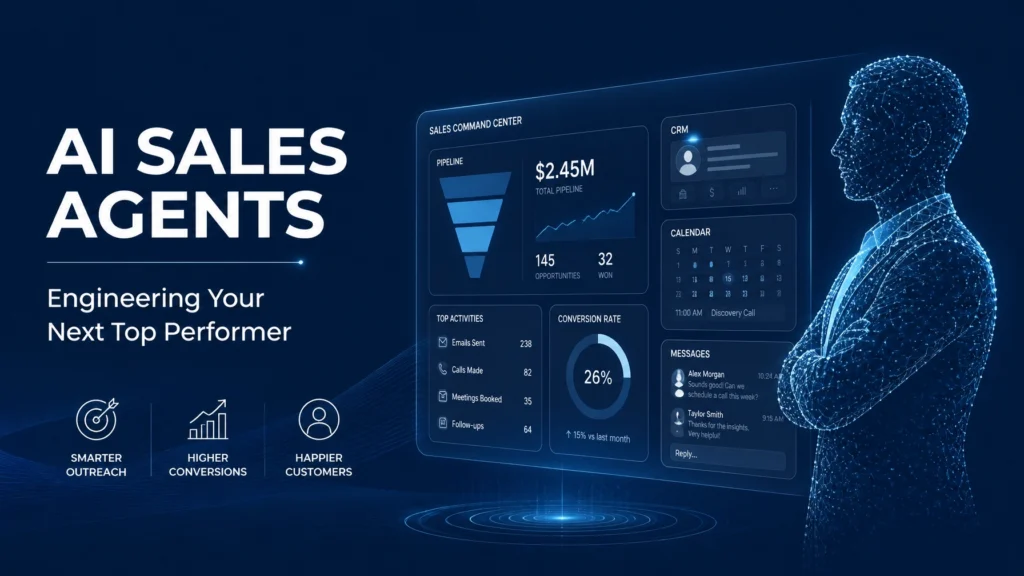
At Delogik Advisory, we don’t view these as just “tools.” We view them through the lens of Revenue Engineering. They are autonomous, goal-oriented systems that serve as an indefatigable extension of your sales team. They don’t just “chat”; they execute. They don’t just “respond”; they convert.
From Chatbots to Autonomous Revenue Engines
The fundamental difference between a legacy chatbot and a modern AI Sales Agent lies in autonomy.
A chatbot is a digital pamphlet. An AI Sales Agent is a digital employee. Powered by Large Language Models (LLMs) and integrated directly into your business tools, these agents are designed to achieve specific outcomes.
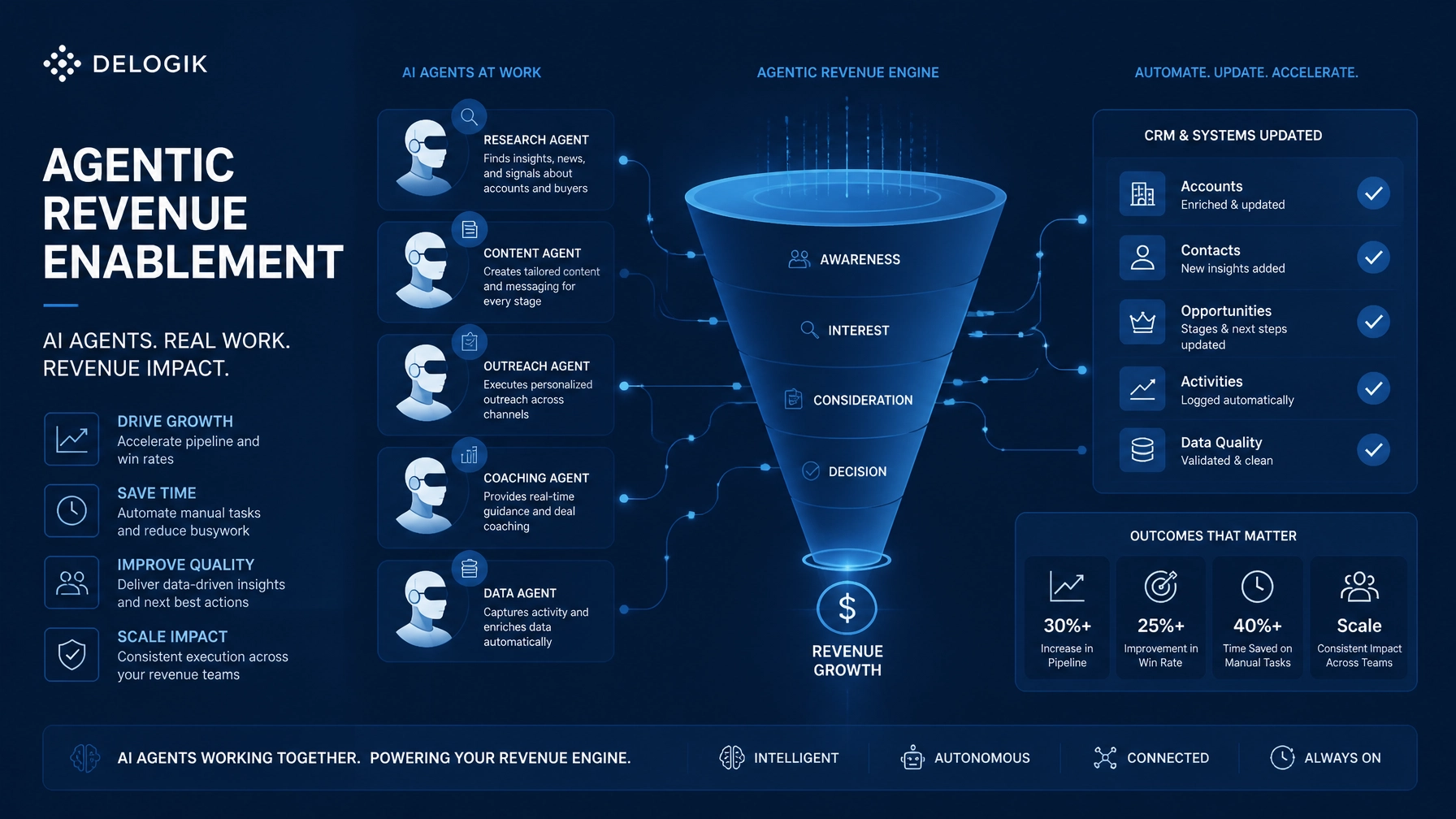
If you give a modern agent a goal, such as “Qualify this list of 100 inbound leads and book meetings for my team,” it doesn’t wait for a user to click a button. It goes to work:
- Deep Research: It scrapes the web to understand the prospect’s current challenges.
- Dynamic Outreach: It drafts personalized, signal-based emails that reflect current market realities.
- Objection Handling: It reads replies and handles nuances (e.g., “We don’t have the budget until Q3”) with the sophistication of a seasoned SDR.
- System Sovereignty: It accesses your calendar APIs to schedule meetings and updates your CRM (HubSpot or Salesforce) in real-time, ensuring your data remains forensic and actionable.
For the growth-minded leader, this isn’t about replacing people. It’s about Human Augmentation. It’s about giving your best people the space to do what AI cannot: build deep, complex human relationships and close the deals that require a “handshake.”

The SMB Sweet Spot: Why You Shouldn’t Wait
Many SMB owners believe that sophisticated AI orchestration is reserved for enterprise giants with massive R&D budgets. This is a misconception. In fact, the $2M–$10M segment is arguably the biggest beneficiary of AI Sales Agents.
Why? Because you lack the “middle management” layer. In a mid-market company, there are teams of people to clean CRM data, research prospects, and follow up on “stale” leads. In your business, if you don’t do it, it doesn’t get done.
By implementing an AI Sales Agent, you are effectively hiring a top-tier SDR that works 24/7, never takes a vacation, and costs a fraction of a full-time executive hire.
Integration: The Nervous System of Your Sales
An AI agent is only as powerful as the data it can access. This is why at Delogik, we emphasize CRM Migration & Implementation as a cornerstone of GTM success. Whether you live in HubSpot or Salesforce, your agent must be tethered to your “System of Record.”
When we architect these systems for clients: like we did for WiseOwl Medical, helping them navigate the complexities of the healthcare market: we focus on creating a bi-directional flow of information. The agent pulls context from the CRM to personalize its approach, and it pushes “live forensics” back into the system so you can see exactly where your revenue is coming from.
“Knowing Your Agent”: The 4 Pillars of Engineering Trust
The biggest fear SMB owners have regarding AI is “brand damage.” The thought of a machine “hallucinating” a product feature or being rude to a long-time prospect is enough to keep any founder up at night.
To achieve System Sovereignty, you must “know” your agent as well as you know your first hire. We break this down into four critical pillars:
1. Persona and Brand Voice
Your agent represents your company. You must explicitly prompt its personality. Is your brand formal and corporate, or witty and conversational? At Delogik, we don’t just tell an AI to “be professional.” We feed it successful historical emails and transcripts to mirror your specific cadence and vocabulary.
2. Boundaries and Guardrails
You must know exactly what your agent cannot do. This is achieved through system prompts and tool restrictions.
- Can the agent offer a discount?
- Is it allowed to promise custom features?
- Does it know when to stop talking and hand the conversation to a human?
Setting these guardrails ensures your brand remains protected.
3. The Ethics of Transparency
In 2026, trust is the ultimate currency. Tricking prospects into thinking they are talking to a human often backfires. We advocate for a “Transparent AI” approach. Give the agent a title that implies its nature: e.g., “Alex, AI Sales Assistant at Delogik.” A highly competent, transparent AI is far more impressive than a deceptive one that makes a mistake.
4. Analytics and Auditing
“Set it and forget it” is a recipe for failure. Knowing your agent means continuously auditing its conversation logs. Are prospects dropping off at a specific objection? Is the AI misunderstanding a common question? By treating your AI agent like a team member who needs “quarterly reviews,” you ensure it stays aligned with your Go-To-Market Strategy.

Revenue Engineering: Building a Permanent Asset
Most marketing tactics are “sugar rushes”: you pay for ads, you get a spike, and then the traffic disappears when the budget runs out.
An AI Sales Agent is different. It is a Revenue Asset.
Once built, refined, and integrated into your Revenue Enablement framework, it remains a permanent part of your infrastructure. It scales as you scale. If you want to double your outreach tomorrow, you don’t need to hire and train five more people; you simply increase the agent’s capacity.
This is what we call moving from “Hustle” to “Systems.” It’s the transition from being an operator who is “in” the business to a leader who is “on” the business.
How Delogik Advisory Helps You Scale
We don’t just “install” AI. We engineer revenue engines. Our three-phase methodology ensures that your AI agents aren’t just cool gadgets, but strategic levers for growth:
- Insight Mining: We audit your current CRM data and sales process to find the bottlenecks where AI will have the highest ROI.
- Direction Design: We architect the agent’s persona, guardrails, and integration points with your existing tech stack.
- Integrated Execution: We deploy the system, monitor the “live forensics,” and train your human team to work alongside their new digital counterparts.

Conclusion: The Path to System Sovereignty
The window for gaining a “first-mover” advantage with AI Sales Agents is closing. In 2026-2027, this will not be a luxury; it will be the baseline for any $10M+ company.
If you are a founder or GTM leader tired of the manual grind, it’s time to stop looking for more “hustle” and start looking for better “engineering.” Whether you are looking to fix a missed target or scale a proven model, an AI Sales Agent can be the top performer you’ve been looking to hire.
Ready to transition from Chief Everything Officer to Strategic Leader?
Explore our CEO Strategy Circle or reach out for a Revenue Architecture Diagnostic to see how we can build your digital sales force.